
Butcher website case study: premium e-commerce for local and nationwide orders.
A practical case study outline showing the commercial thinking behind the design, content, mobile experience, SEO structure and expected business outcome.
The problem
A traditional food business needs to move beyond social media enquiries and give customers a trustworthy way to browse products, understand delivery, build orders and buy online.
The solution
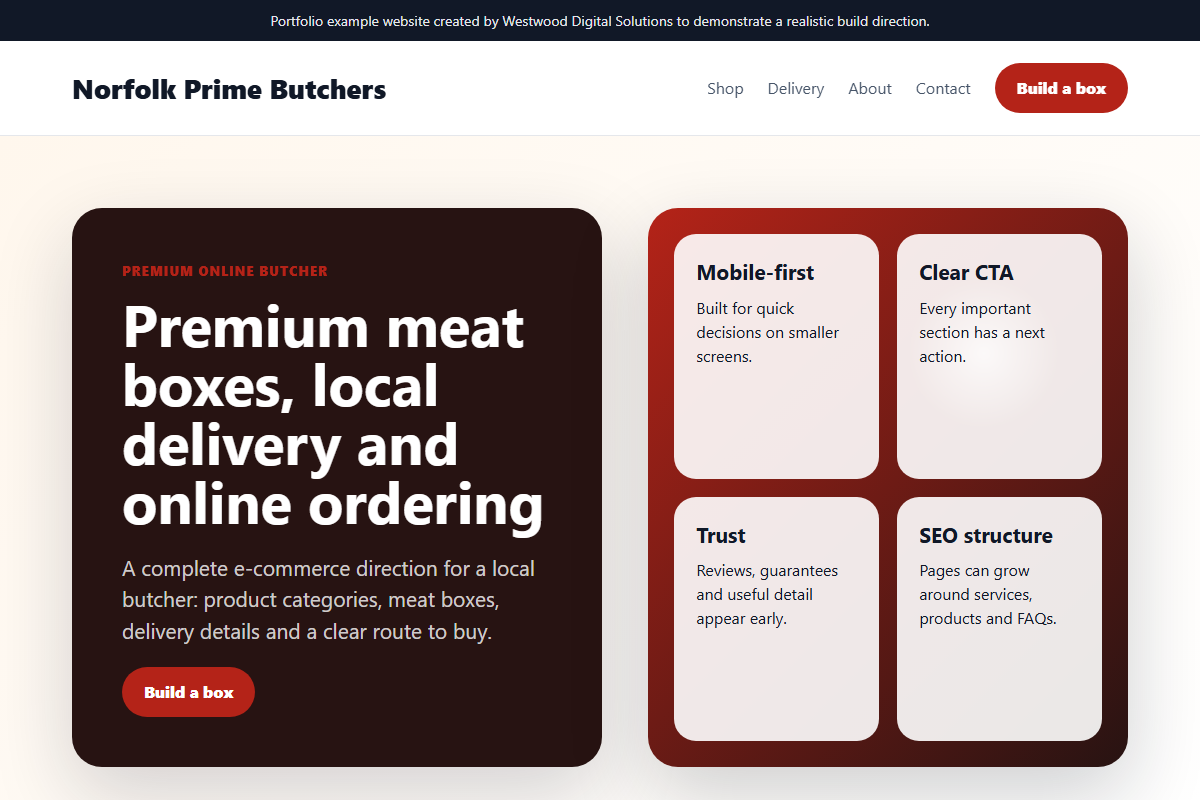
The proposed solution is a premium e-commerce website with strong product storytelling, category structure, delivery messaging and a build-your-own box journey that creates a clear point of difference.
Features built
Product catalogue, category pages, secure checkout planning, customer accounts, delivery configuration, box builder journey, live pricing prompts, product recommendations and analytics-ready structure.
Mobile view
The mobile view prioritises quick product discovery, clear basket access, thumb-friendly calls-to-action and delivery reassurance before checkout.
SEO considerations
SEO considerations include butcher, meat boxes, local delivery, nationwide delivery, product category pages, schema markup, image alt text and internal links from service pages.
Expected business outcome
Expected outcomes include more online orders, higher average order value, fewer manual enquiries and stronger repeat-purchase opportunities.
Want work like this, but scoped around your business?
Send your current website, product range or workflow problem and I will suggest practical next steps.
Commercial objective
The aim of this butcher e-commerce website concept is not only to make the business look more professional. The aim is to create a website that can support real sales conversations: clearer positioning, stronger trust, better mobile usability and a more structured route from first visit to enquiry or order.
Discovery and planning
For a local butcher, the planning stage starts with the customer journey. Visitors need to understand what is offered, whether the business serves their area, what makes it different, and what action to take next. The page structure is designed around those questions rather than around generic brochure sections.
Design decisions
The visual direction uses clear hierarchy, strong calls-to-action, readable sections and proof-led content. The design avoids clutter and gives priority to online ordering, delivery messaging and premium product presentation. This makes the site easier to use on mobile, where most local buyers will first inspect the business.
SEO structure
- Descriptive page title and single clear H1.
- Service-led headings using natural customer language.
- Internal links to relevant services and contact pages.
- Image alt text written for context, not keyword stuffing.
- Schema markup and sitemap inclusion where the page should be indexed.
Result expected
The expected result is a website that feels credible immediately, explains the offer without confusion and reduces the number of weak or repetitive enquiries. For a small business, that matters because better-qualified leads save time and improve the chance of turning website traffic into actual revenue.
How this can be adapted
The same structure can be adapted for trades, food businesses, clinics, e-commerce stores and professional services. The industry changes, but the commercial framework stays the same: clear offer, local relevance, proof, simple enquiry route and measurable follow-up.